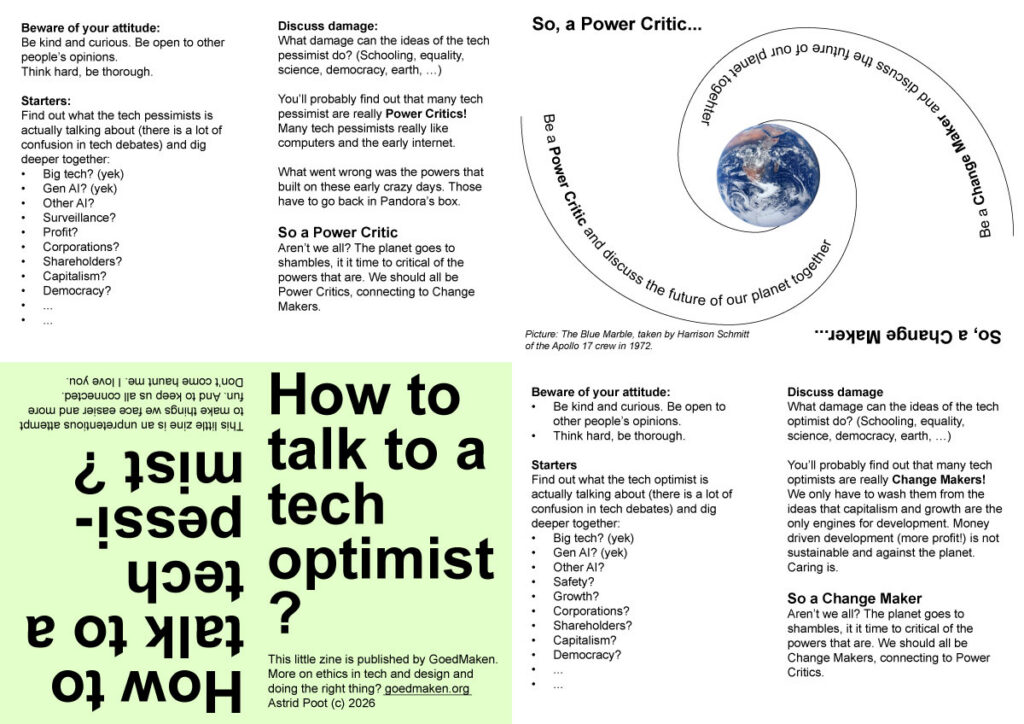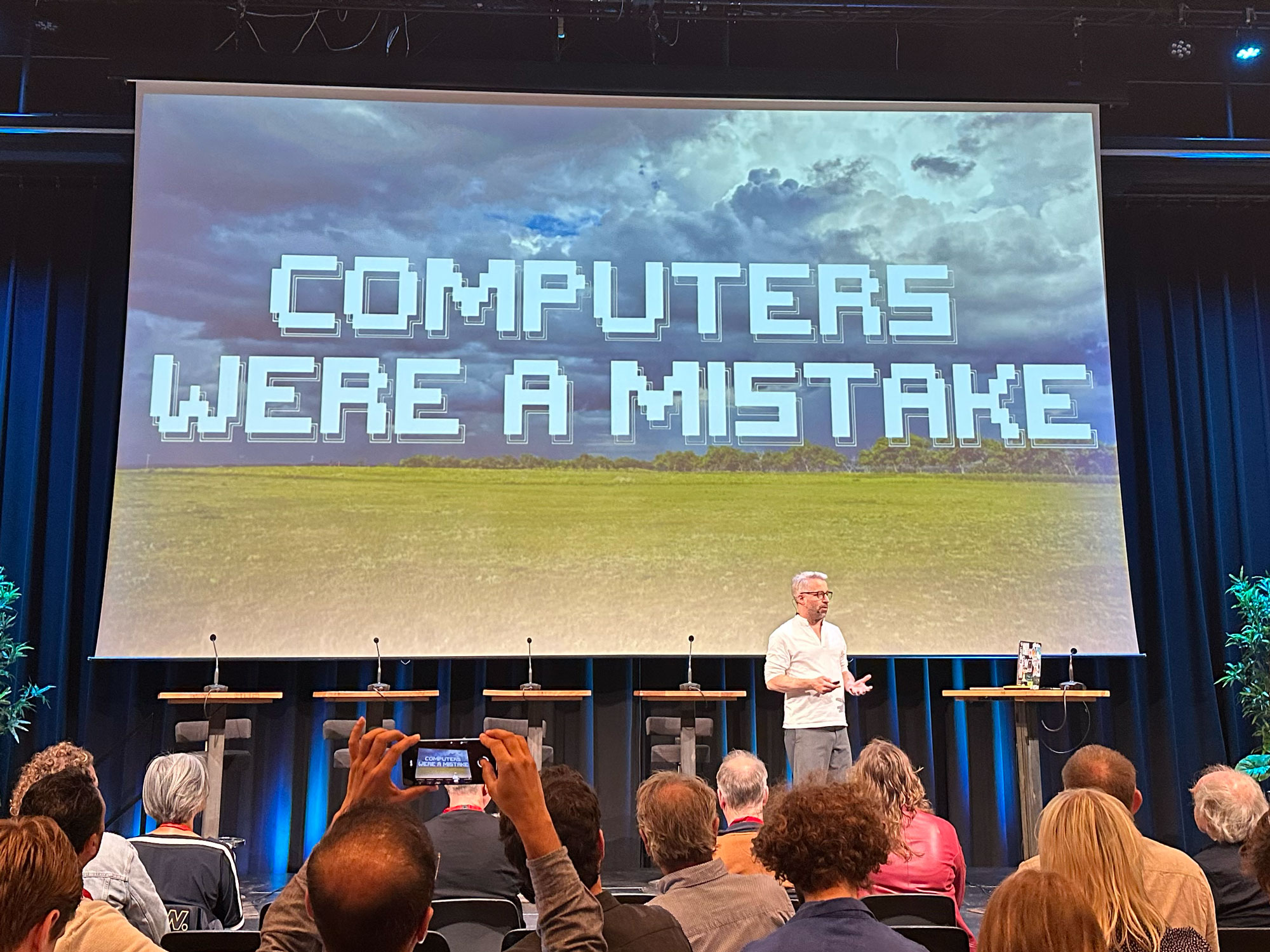
I was at the Public Spaces Conference in Amsterdam. And although many very good lectures, books and blogs can be accessed online, being in a room with likeminded people is a comfort and an inspiration. I’ll share some highlights and my new zine: How to talk to a tech-pessimist and/or tech-optimist.
First the highlights.
Hope
Opening keynote was Robin Berjon: technologist, democracy activist and much more. You van watch his talk here, or read my short summary below. He crunched our should be attitude and must do tasks into 9 bullets.
- Strategise – Current power is the infrastructure (email, payments, AI, chat, cloud, social). Strategy is to create power: we need to build and use alternatives.
- Provide – Provide a public infrastructure so people van build on that en make and use their own stuff.
- Democratise – The discussions about decentralisation are often foggy. They often tackle accesability but it should be about voice.
- Commoditise – Use standards. Know that we can do shit. Start rebuilding the top 10 api’s, that’s power for you!
- Leapfrog – We trained ourselves to be helpless towards computers. We don’t have to accept that. We need to leap out.
- Disintermediate – Get rid of the intermediairs. Remove the power from the big browsers (Chrome), service companies (Adobe) and publishing houses. Make an open standard market place.
- Decartelise – Get rid of the cartels. Google and the browsers make a lot of money, money that is not invested or available on our www.
- Switch – It should not be painful of difficult to use ethical alternatives. Software should be up to parr, yes. But also consider this: are you sticking to a service because the usability is so good or out of habit? Make room to learn new software.
- Fight! The time for dialog is long gone. We have no friends in big tech. They are against democracy and against us.
We build on hope:
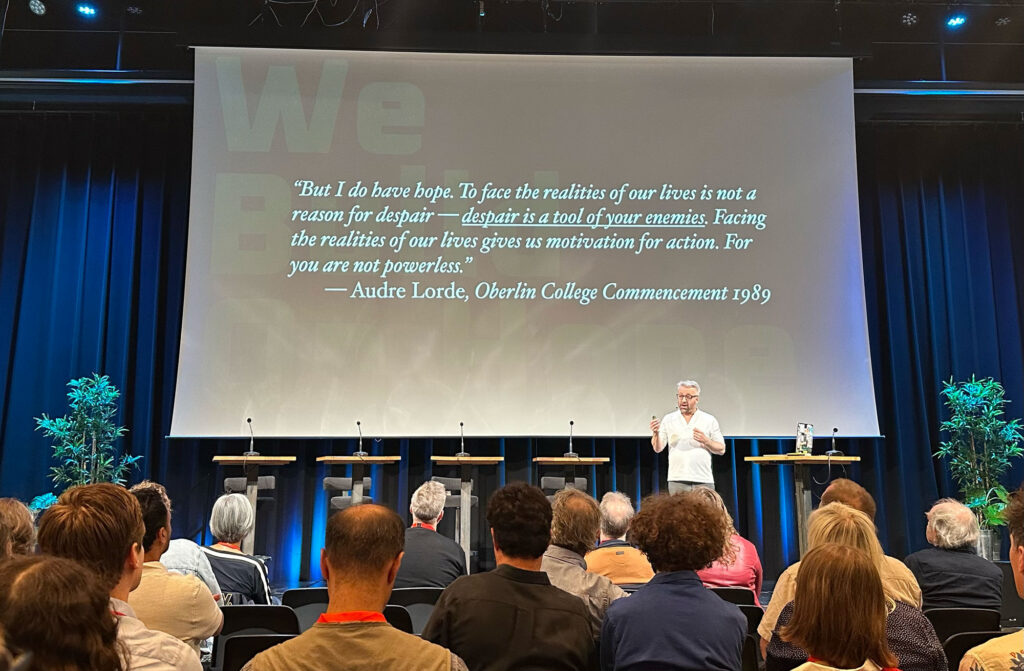
Watch his talk here, thank you Robin Berjon.
Panel: fight for your right to party
(If you now hear the song in your head you are definitely one of the cool crowd.)
Usually I don’t like panels much: every one has their say and waits polite and there is usually too little time per speaker and no slides to look at. BUT: this panel was rocking! Stars: Marleen Stikker, Robin Berjan, Matthias Pfeffer.
Strong start: the attention for Europe and the EU from the USA had one goal: to destroy our democracy. Fascism is a kind way to describe that. (MP)
And we are behaving as if we are defeated: big tech so big, we so small… We got to believe in the wrong stories: clever computers, man as machine, brain as a computer. Ditch this narrative en grab the power back! (MS)
Politicians don’t understand what is happening. The follow the big tech narrative. (Inevitable innovation!) Our political leaders are followers, they are our followers. The should do what we want, democracy baby! Bring the demo, not the memo. (RB)
That reminds me of the for ever important Hannah Arendt (not a quote, my interpretation): The only cure against a totalitarian movement is a Real People Movement. Be visible, but as a group. And then act: express a collective opinion as a collective and force change together. Use your despair as fuel. Zines here and here.
As Europe we are caught in the startup storyline: Rules are limiting progress, we need private capital, scale-ups, etc. (Rapport Wennink) Politicians talk big tech because they are influenced by big tech. We must act from public values, it is our money after all! (MS)
That can only happen of we have a lobby that is similar in power. (MP)
How to get there? By having fun, and making stuff. Be active citizens, raise our voices. We are where the party is at.
Watch the panel here. It’s worth it. Thanks!
AI and education, primary school
Last session I got into left me confused. It was al small panel talking about the role of AI in primary schools. Guests: Jan Jaap Hubeek, Siri Berends and Karmijn Stekelenburg, hosted by Björn Wijers.
This session told me that to very firmly be in different camps won’t change anything. Two of the guests seemed to be at ends of the tech debate spectrum: Siri Berends (Setup) is very critical about AI in education , Karmijn Stekelenburg (Nolai) develops projects that use AI in education. I admire Siri Berends very much and use her work as a moral guide in my thinking. And my neck hair raises a bit as I feel the tech-optimism in the Nolai report on AI in education. So I am biased, leaning towards the no.
But: not being a teacher facing the reality of work pressure, pupils high on ChatGPT and other big tech drama makes it easy to have strong principles and speak out against AI. And schools and teachers do benefit from AI as one of the people of teacher lead publisher NEON stated from the audience. And as is stated in the Nolai report. And the examples Karmijn Stekelenburg gave are interesting and rooted in reality.
I would have liked to hear more discussion between the two woman. What AI are we talking about? What is the common ground? We could have dug deeper easily and learned more. We know the differences, now we have to look for the solutions.
So I made a zine
That got me thinking. Are we as far away from each-other as we are positioned in these discussions? I don’t think so. So I made a zine: How to talk to a tech-pessimist and/or tech-optimist. Download, print, share.